The J Spiral
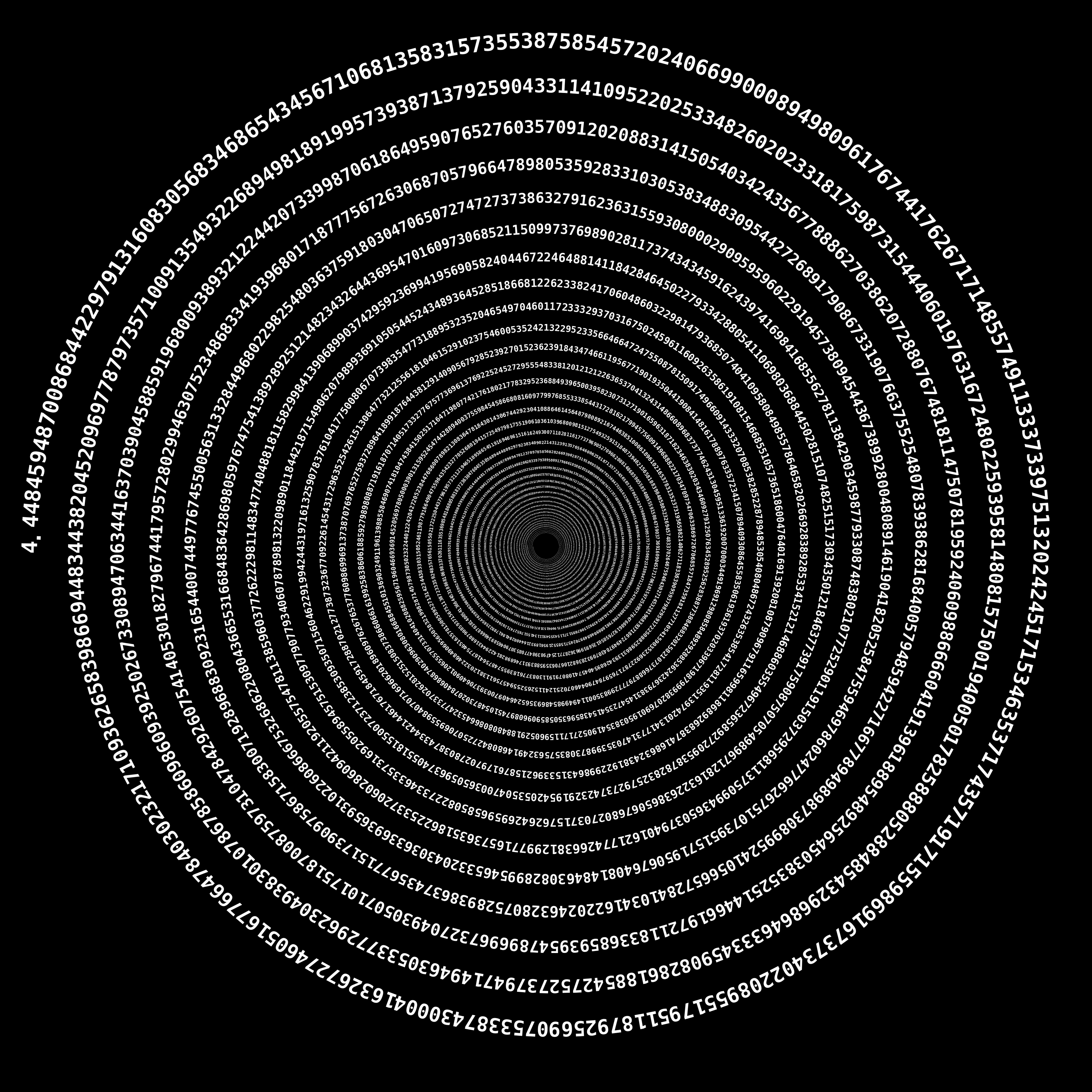
Abstract. Of every spiral family explored in this project (linear, hyperbolic, power-law, 3D extensions — see Sec. 8), exactly one has a property that holds not just for a single revolution, but recursively, forever: the logarithmic spiral r(θ) = R·e^(−kθ), with k chosen so that one revolution's arc length equals exactly 3·d. We call this curve the J Spiral, and its defining constant the J Constant (logarithmic), J ≈ 4.4485%. Every other branch in this project was an experiment in the same direction — a different answer to "how should r(θ) decay?" — but only the logarithmic answer turns out to be exact at every scale, infinitely. This page documents that result: its definitions, its proof of uniqueness, the deep-decimal anatomy of J itself, and the full set of visual, live, and audio artifacts built from it.
01Naming — Why "The J Spiral"
a circle that refuses to closeA circle of diameter d has circumference π·d. If you instead build a spiral whose first revolution has arc length exactly 3·d — using the "naive" substitution π → 3 — the curve cannot close back into a circle, because 3 < π. It is geometrically forced to spiral inward by a fixed amount every revolution.
Among all the curves that satisfy this constraint for their first revolution (Sec. 8 walks through several), the logarithmic spiral is the only one for which the constraint keeps being true forever — every revolution, at every scale, has arc length exactly 3 times its own diameter (proved in Sec. 3). That recursive exactness is what earns this particular curve its own name, rather than being just "a logarithmic spiral with some k."
02Definitions — Basic & Scientific
two ways to say the same thing2.1Basic definition
J% is the percentage by which the J Spiral's radius shrinks after one full revolution, when that revolution is built so its arc length equals exactly 3 diameters instead of π diameters — i.e. "what if π were exactly 3?" J is the size of the gap left behind by that 0.1416 shortfall, expressed as a percentage of the diameter.
2.2Scientific definition
For the logarithmic spiral r(θ) = R·e^(−kθ), let k be the unique positive root of:
i.e. the arc length of one revolution equals 3 diameters. Define the self-similarity ratio as ratio = e^(−2πk) = r(2π)/R. Then:
J is the percentage of the diameter "lost" between the start and end radius of a single revolution — the geometric residue produced by substituting 3 for π in the relationship between a circle's circumference and its diameter.
03Why This Spiral Is Unique
the constraint holds at every scale, foreverDefine dn = diameter at the start of revolution n, and Ln = arc length of revolution n (θ ∈ [n·2π, (n+1)·2π]). Every branch in this project is built so that L₀ = 3·d₀ by construction. The question is: does Ln = 3·dn for n > 0 too — or was the "3×diameter" property only ever true for the very first loop?
For the J Spiral, both dn and Ln scale by the exact same factor (ration) every revolution, because r(θ) = R·e^(−kθ) is self-similar — revolution n is a perfect scaled copy of revolution 0:
This was verified directly, loop by loop, across 24 revolutions — not assumed, computed:
| loop n | dn | Ln | Ln / dn |
|---|---|---|---|
| 0 | 10.000000 | 30.000000 | 3.00000000 |
| 1 | 9.110308 | 27.330924 | 3.00000000 |
| 4 | 6.888620 | 20.665861 | 3.00000000 |
| 8 | 4.745309 | 14.235928 | 3.00000000 |
| 12 | 3.268863 | 9.806590 | 3.00000000 |
| 16 | 2.251796 | 6.755388 | 3.00000000 |
| 20 | 1.551177 | 4.653530 | 3.00000000 |
| 23 | 1.172899 | 3.518696 | 3.00000000 |
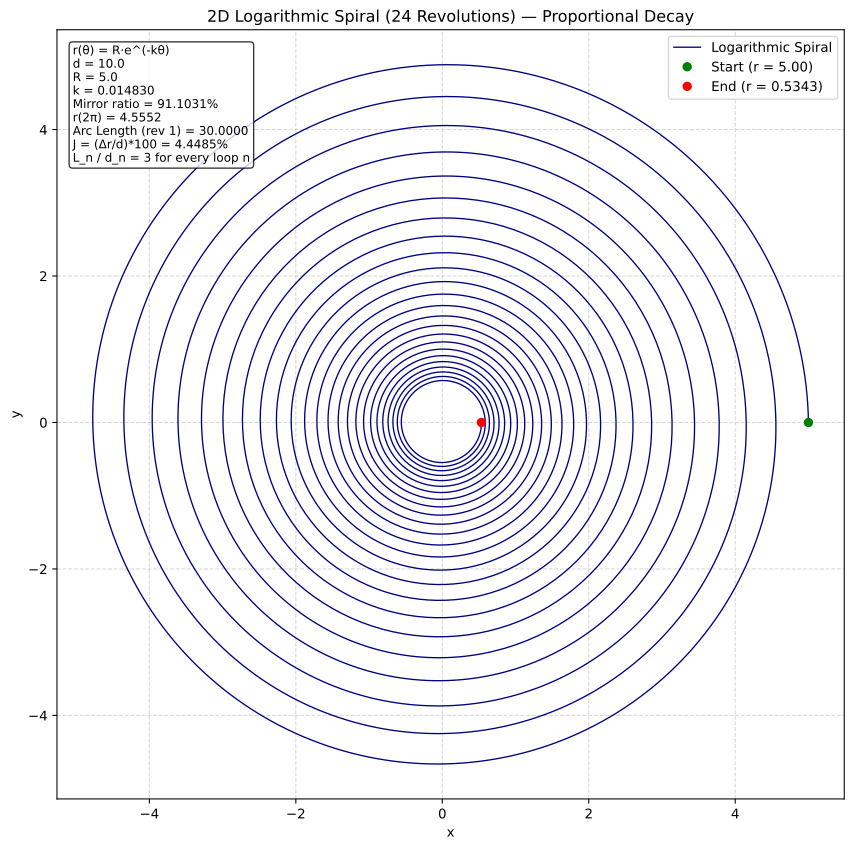
Also verified: r(θ) = R·e^(−kθ) is a single smooth function with no hardcoded per-revolution resets, and d₁ = d₀·(1 − 2J) emerges as a direct algebraic consequence of J's own definition — not a coincidence requiring separate proof.
3.1Compared to every other branch
No other branch in this project has this property. A linear (Archimedean) spiral has a constant Δr per revolution, so the ratio dn+1/dn drifts — the same absolute Δr becomes a larger fraction of a shrinking diameter, so Ln/dn ≠ 3 for n > 0. Hyperbolic and power-law spirals behave similarly: L₀ = 3d₀ by construction, but the ratio is not preserved. The J Spiral is the only branch where "3×diameter" is true at every scale — which is also exactly why it is the only branch capable of the infinite fly-through animations in Sec. 5.
04The Anatomy of J
10,000 decimal digits, examined honestlyJ was computed to 10,000 decimal places using arbitrary-precision arithmetic (mpmath, 10,060 digits of working precision), then examined for hidden structure: digit statistics, continued fraction expansion, and an inverse-symbolic search against classical constants.
4.1Digit statistics (first 10,000 decimals)
Every test result is consistent with what you'd expect from a statistically normal, generic irrational number — no bias, no periodicity, no embedded patterns.
4.2Continued fraction expansion
These look like a textbook "generic irrational" — small integers distributed roughly per Gauss-Kuzmin statistics, with no periodicity (periodicity would mean J is a quadratic irrational — a root of an integer-coefficient quadratic — it is not). The standout values — 43 at position 11 of CF(J), 67 at position 2 of CF(k) — just mean an unusually good rational approximation exists at that point; this happens routinely in any irrational's expansion (π's CF has a famous 292) and is not evidence of structure.
4.3Inverse symbolic search
mpmath.identify() searched J, J/100, ratio, k, k·2π, and
−ln(ratio) for a closed-form expression in terms of
{π, e, φ, √2, √3, ln2, Catalan, Euler-Mascheroni}.
This is the expected, honest outcome. J is the root of a "mixed" equation — √(1+k²)/k (algebraic) combined with e^(−2πk) (transcendental in the exponent). Equations that mix algebraic and exponential terms this way essentially never have elementary closed-form solutions (not even Lambert W, because of the extra √(1+k²)/k factor). There was never a structural reason to expect J to relate to π, e, or φ in a simple way.
4.4Verdict
J appears to be a generic transcendental number specific to this geometric construction — a real, well-defined mathematical object, with no detected relation to classical constants. Its specialness is geometric (Sec. 3), not numerological: it is the unique self-similar spiral with the 3×diameter property, and that is where its significance lies.
05Visual Gallery
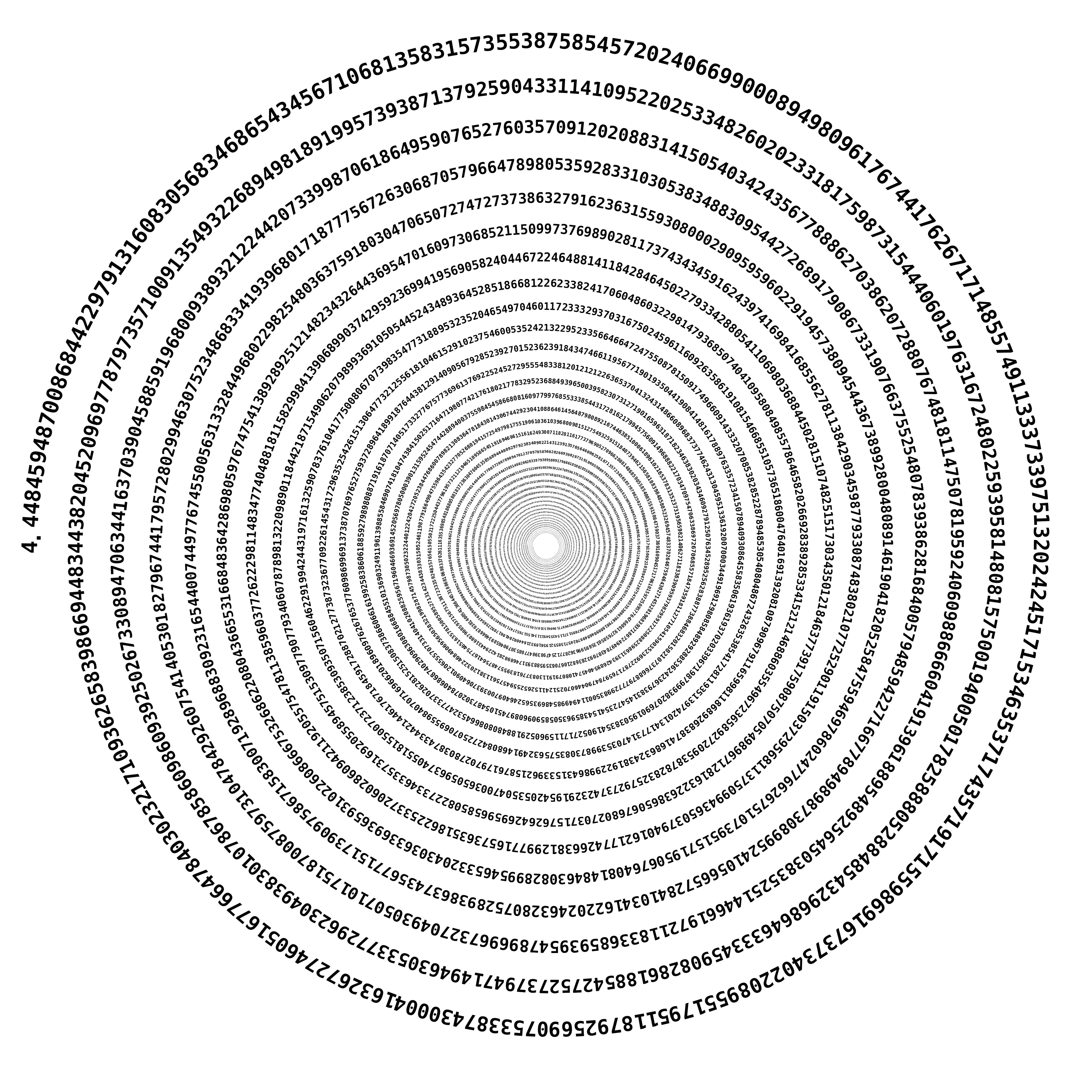
the J Spiral, rendered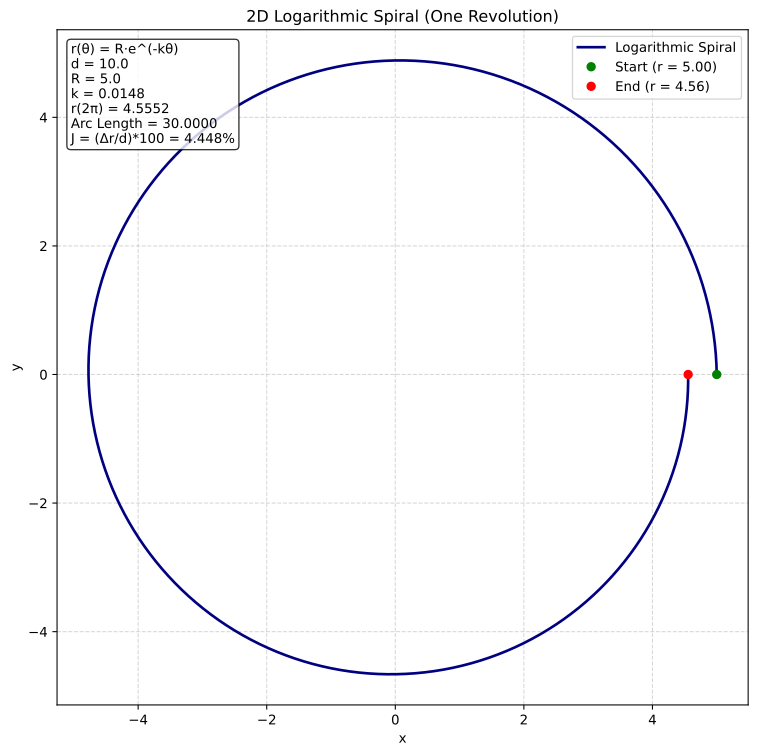
06Live — Inside the J Spiral
running in your browser, no video files
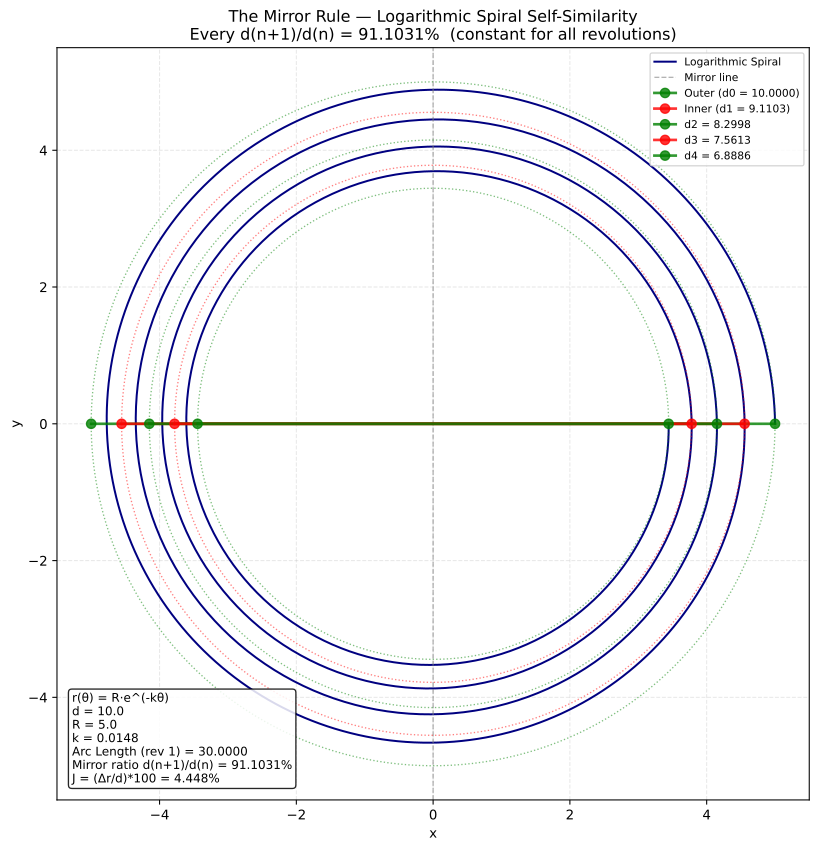
Because the J Spiral is exactly self-similar — every revolution is the
same shape, scaled by 0.911031 — it is the only branch that supports
true infinite "fly-through" animation. These run live, computed
frame-by-frame in JS/Canvas directly from
j_constant_logarithmic_unwind.py,
j_constant_logarithmic_zoom.py, and
j_constant_logarithmic_tunnel.py.
6.1Self-Similar Unwind
The spiral drawn frame-by-frame across 12 revolutions, colored by revolution.
6.2Push-In (2D Camera Dolly)
The full spiral is drawn once; the camera zooms in at the same 91.1031% rate per revolution as the spiral itself shrinks — the spiral appears to hold still while the viewer flies toward the center.
6.3The Tunnel (3D + Perspective)
The spiral extruded along a depth axis into a helix and flown through with a pinhole camera.
07Sonification
J as pitchThe same exponential law that defines the J Spiral's radius defines a continuous pitch glide: f(θ) = A4 · e^(−kθ) = A4 · r(θ)/R. Because pitch perception is logarithmic, this exponential decay produces a perfectly linear glide in cents — a constant-rate portamento, directly audible as the spiral's own decay rate.
08The Experiments — Everything That Led Here
attempts at the same purity, before this oneEvery branch below answers the same question — "if a string of length 3d spirals once around a circle, how does r(θ) decay?" — with a different decay law. None of them survive Sec. 3's recursive test (Ln = 3·dn for all n); the J Spiral (Sec. 1–3) is the only one that does. This section is the full research trail — every model, every figure, every dead end — that led to that result.
8.1The Baseline — Type-A Archimedean
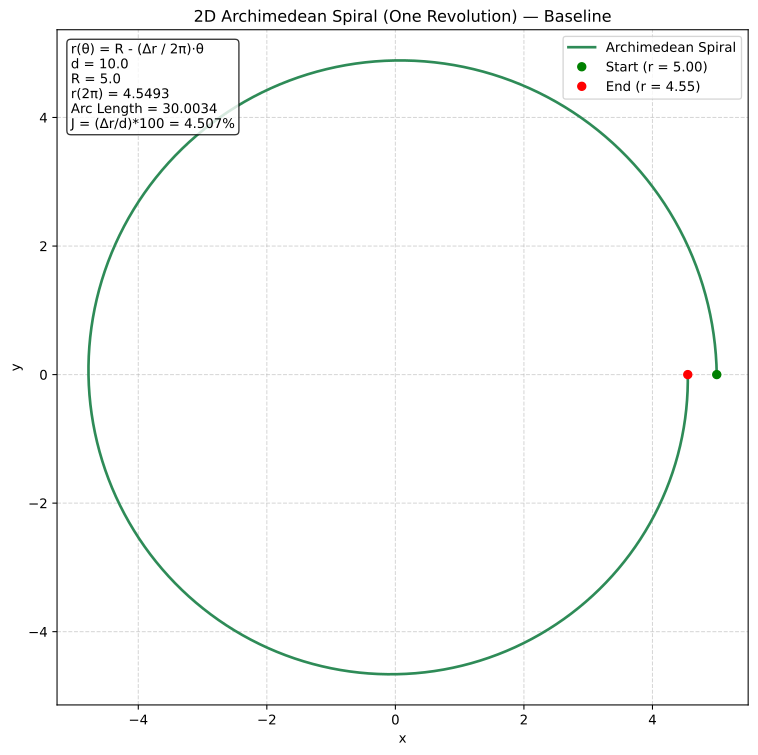
closed form, J = 1 − 3/πThe simplest possible model: a linear (Archimedean) spiral where the radius decreases by a fixed total amount Δr over one revolution, with Δr defined directly from the π-vs-3 discrepancy:
Note that the 2D arc length of this curve (30.0034) is already almost exactly 30 — the "naive" Δr derived from 1 − 3/π happens to produce a curve whose own length is barely different from the 3·d target. This is the seed observation that everything else grew from.
8.2New Archimedean — Type-B Reformulation
arc length fixed at exactly 3d = 30
Type-A defines Δr first (from 1 − 3/π) and only checks the
arc length afterward. Type-B inverts the logic: it
fixes the arc length at exactly 3·d = 30 and solves
for whatever linear decay rate k makes that true, via
scipy.optimize.minimize_scalar. This is the "honest"
version — it takes the constraint ("a string of length 3d") literally
and lets Δr fall out as a result.
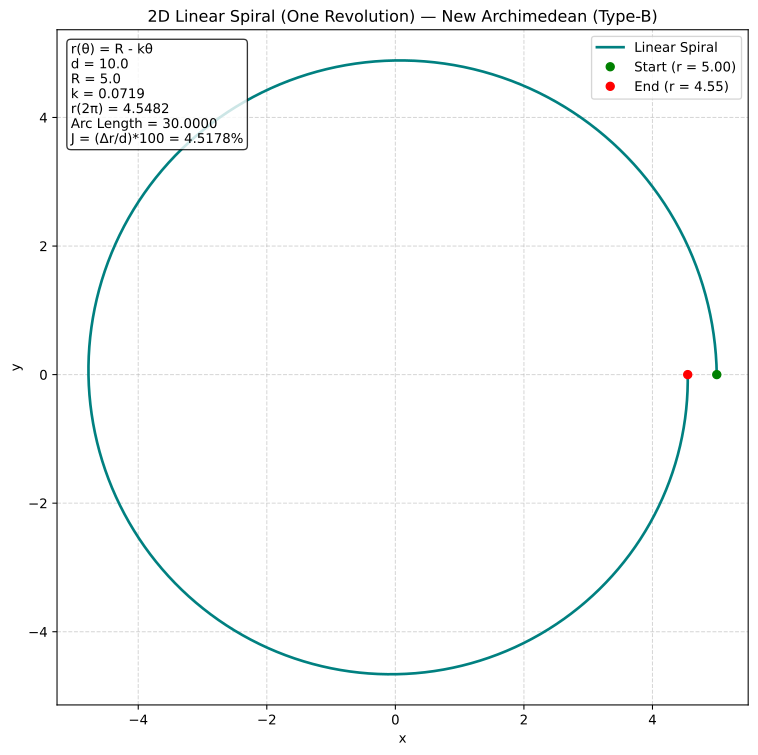
The two values — 4.507% (Type-A) and 4.5178% (Type-B) — are close but not identical. The difference (≈0.011 percentage points) is the "diagonal tax": a straight line of length 3d traces slightly less radial distance than a pure radial drop of 1 − 3/π would suggest, because some of that length is spent going around, not just in.
8.3Alternative Decay Laws — Hyperbolic
same constraint, different shapeSolved under the exact same constraint (arc length = 3d = 30, one revolution), the hyperbolic spiral produces the lowest J of any "natural" decay law tried:
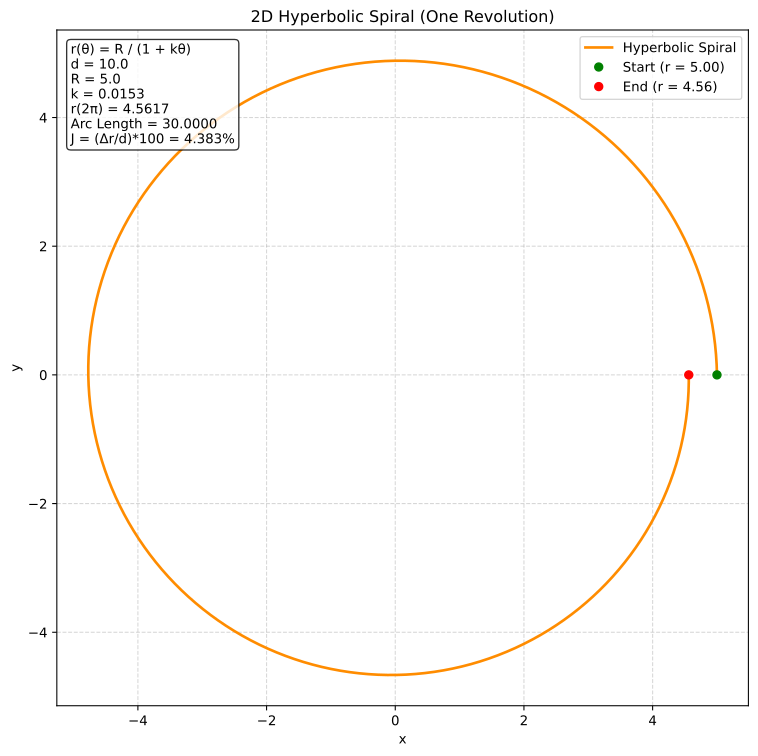
r(θ) = R / (1 + kθ), k = 0.015293
J = 4.3832%
Unlike the logarithmic case (Sec. 1–3), neither this hyperbolic decay nor the linear decays above preserve the 3×diameter ratio beyond revolution 0 — only the logarithmic spiral is recursively self-similar, which is why it became the J Spiral.
8.43D Extensions — Perfect Symmetry & Gravity Well
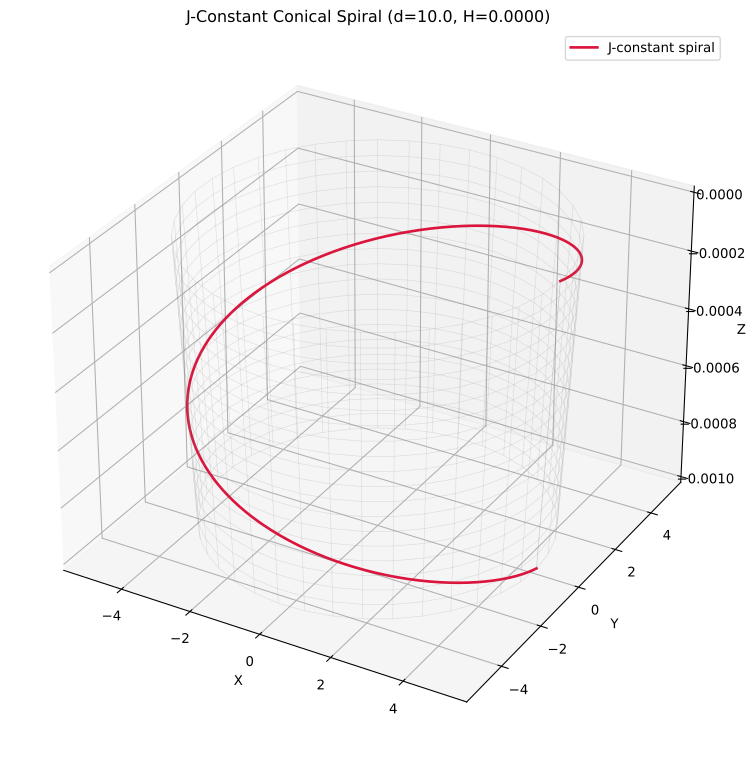
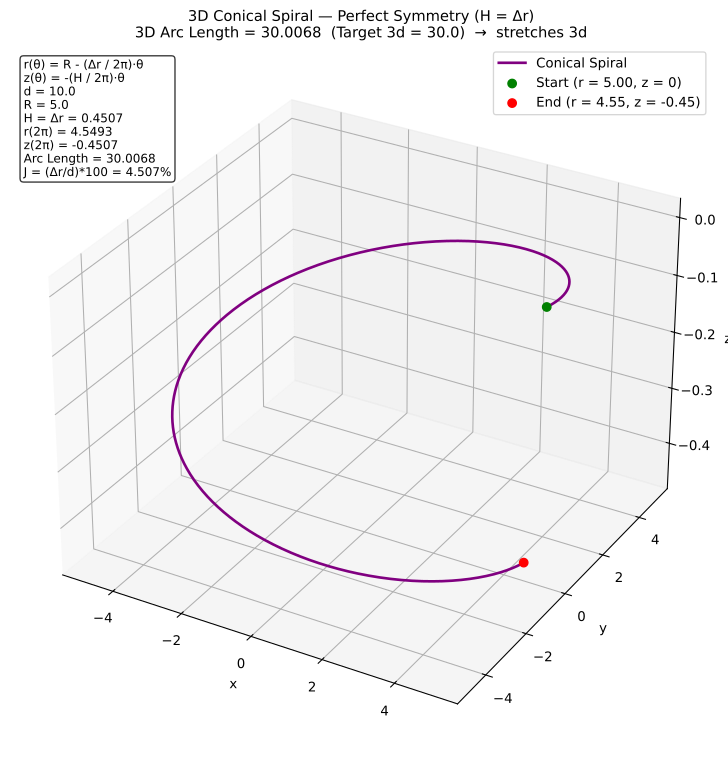
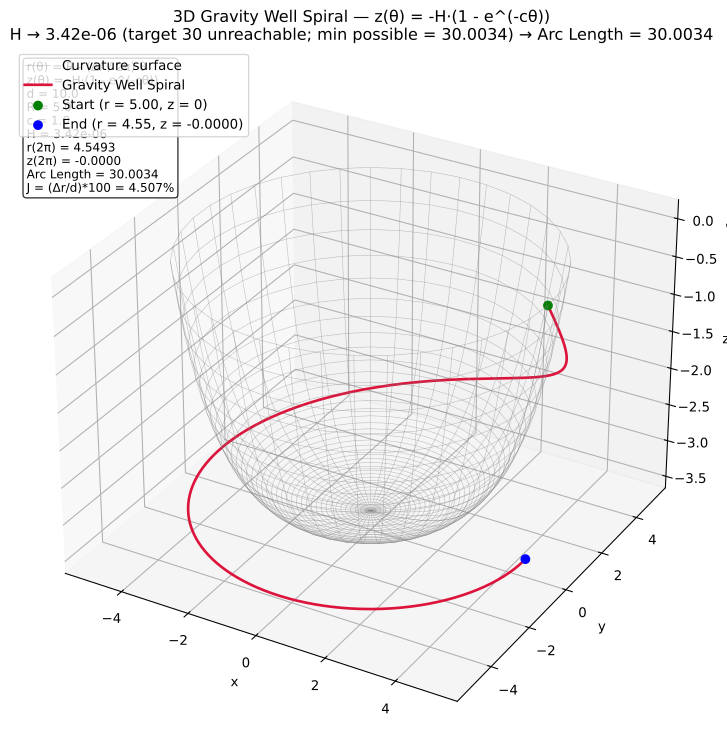
adding a depth axis z(θ)Both 3D variants keep the same 2D radial decay (Type-A: r(θ) = R − (Δr/2π)θ) and add a depth coordinate z(θ), then ask whether the 3D arc length can still be made to equal 3d = 30.
Perfect Symmetry — H = Δr
Gravity Well — z(θ) = −H·(1 − e^(−cθ))
Here we ask the inverse question: solve for H such that the 3D arc length hits exactly 30. The result is a mathematical dead end — worth keeping for what it reveals.
Because any nonzero depth only adds length, and the flat curve already exceeds 30 by 0.0034, no H ≥ 0 reaches exactly 30. H → 0 is the closest possible answer — i.e. the "gravity well" wants to be perfectly flat.
8.5The J(p) Landscape
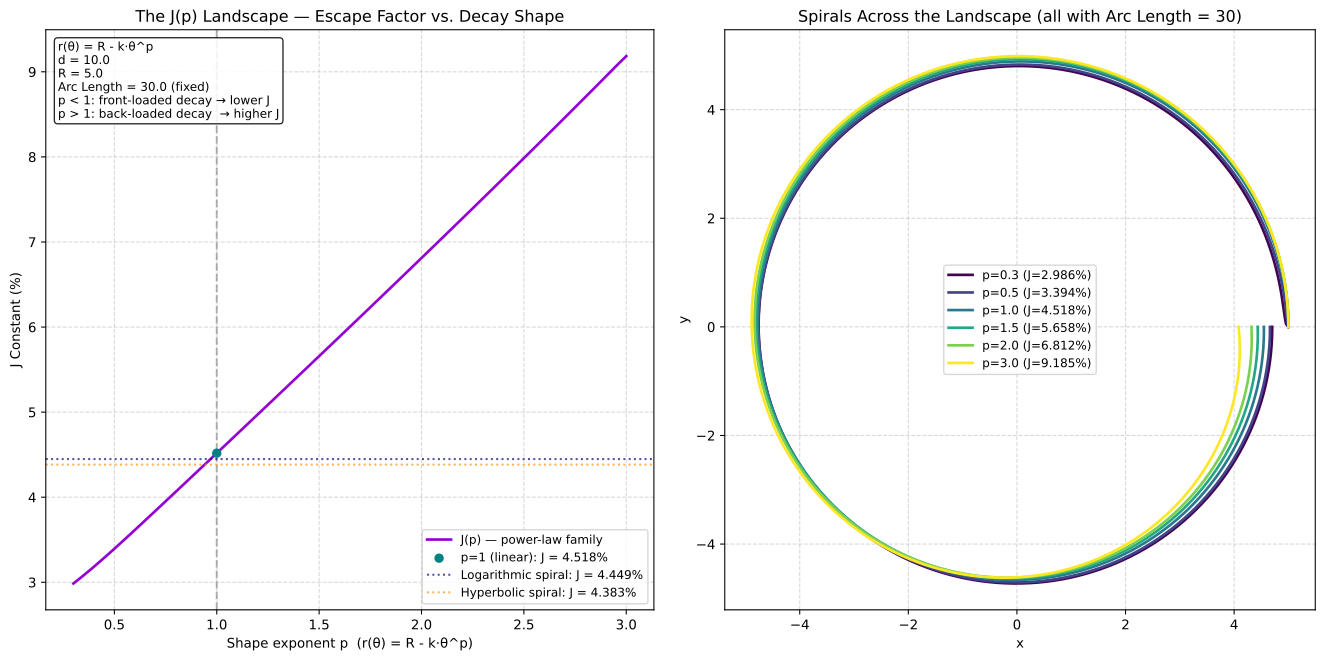
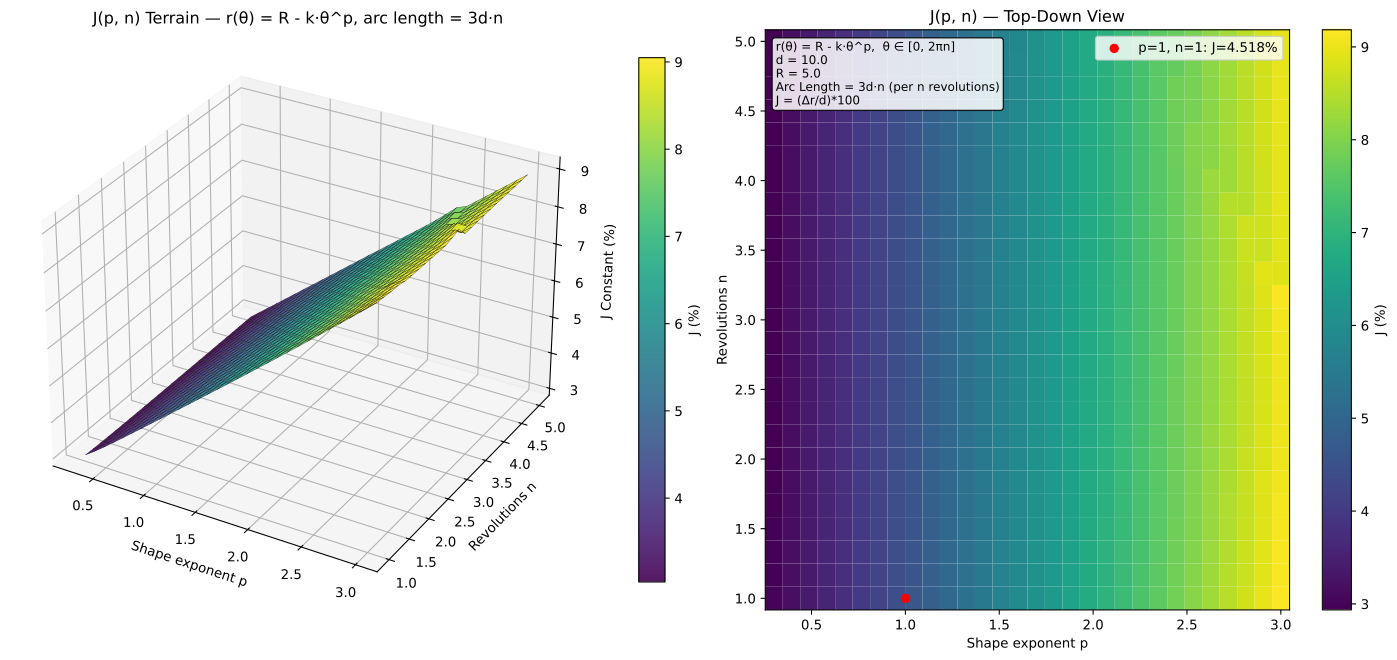
power-law family, r(θ) = R − k·θ^pGeneralizing the decay law to r(θ) = R − k·θp (with k re-solved for every p so the arc length is always exactly 30) lets us sweep a continuous "shape" parameter p and watch J respond.
- p < 1 — front-loaded decay (drops fast early) → lower J
- p = 1 — linear (New Archimedean) → J = 4.5178%
- p > 1 — back-loaded decay (drops late) → higher J
Extending the same sweep to multiple revolutions n gives a full 2-parameter surface J(p, n):
8.6Phase Portraits — The "DNA" of Each Spiral
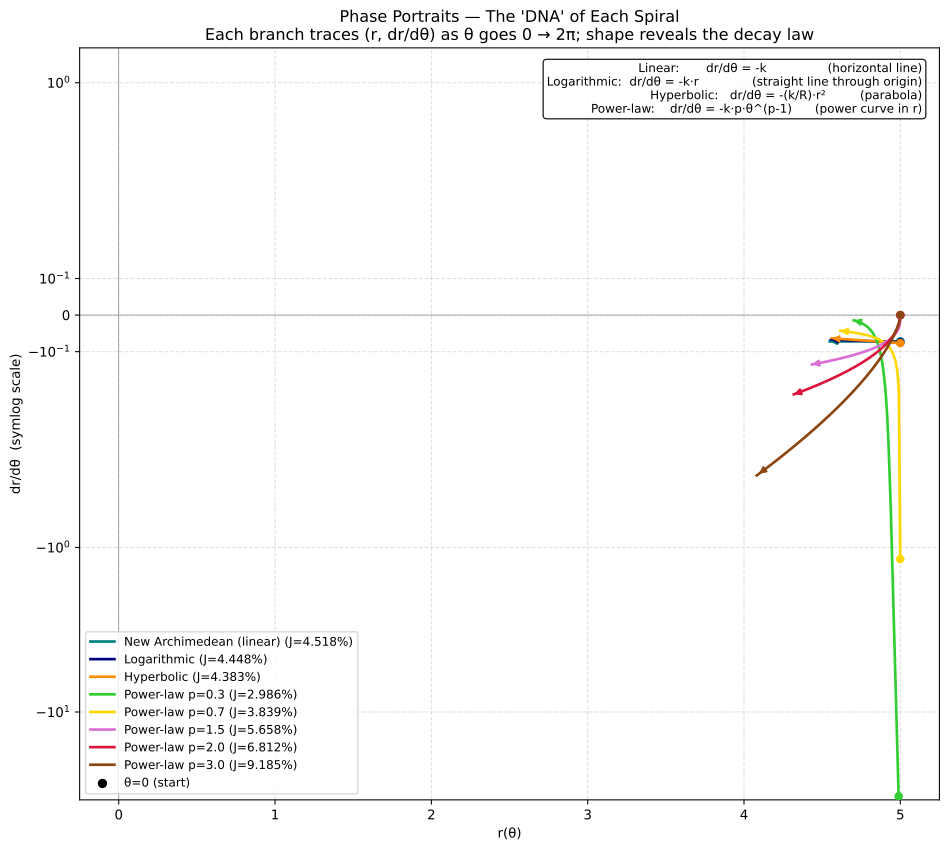
r vs. dr/dθPlotting each branch's (r, dr/dθ) trajectory as θ goes 0 → 2π reveals the shape of its decay law independent of its absolute scale:
8.7Art Series — The Same Math, Pushed Toward the Visual
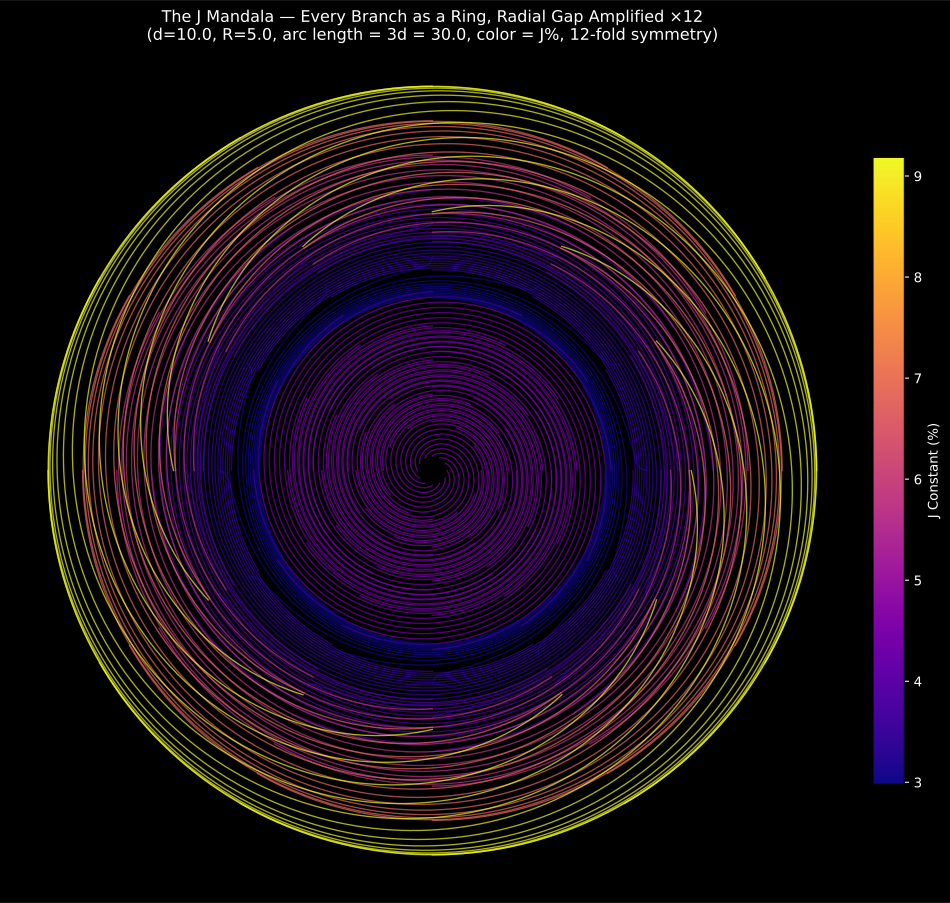
generative art built on JThe J Mandala
Every branch becomes a ring; its radial variation (the J gap) is amplified ×12 and repeated with 12-fold rotational symmetry. Color encodes J%.
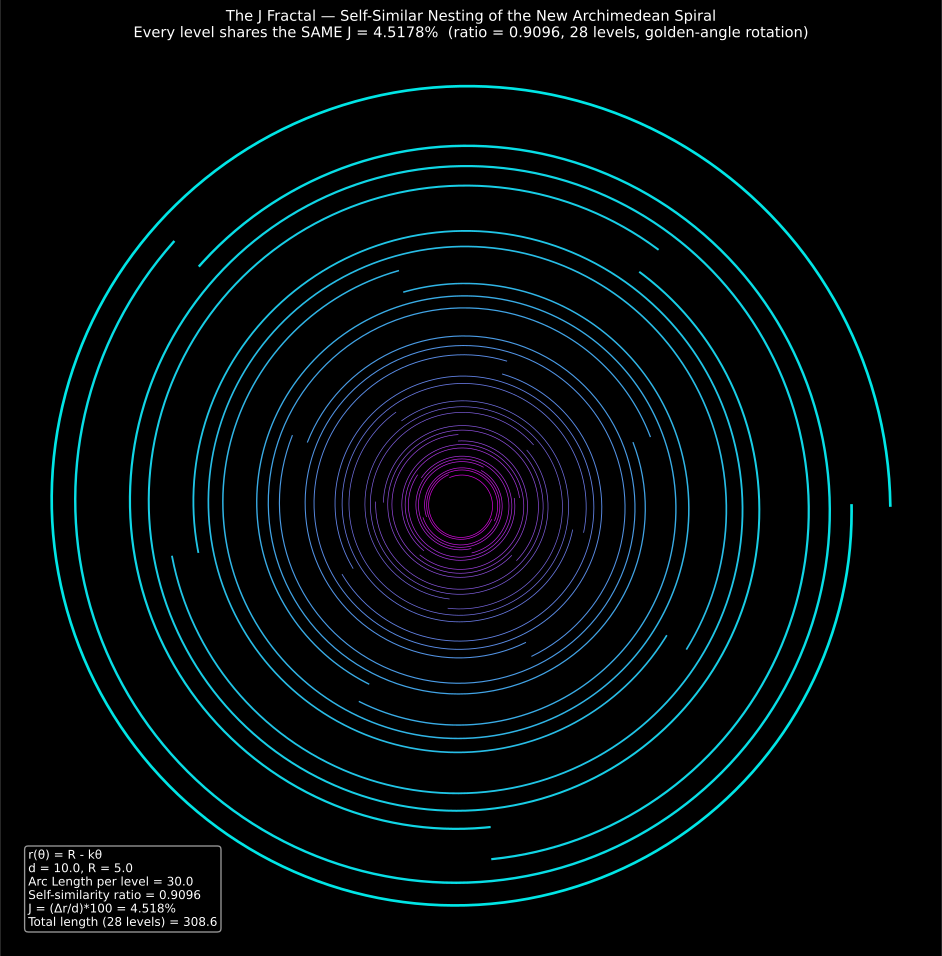
The J Fractal Nest
The New Archimedean spiral (ratio = r(2π)/R = 0.909643) nested 28 times with golden-angle rotation between levels. Because the decay is linear, every nested level shares the same J = 4.5178%.
Shape Morph (animation, static preview)
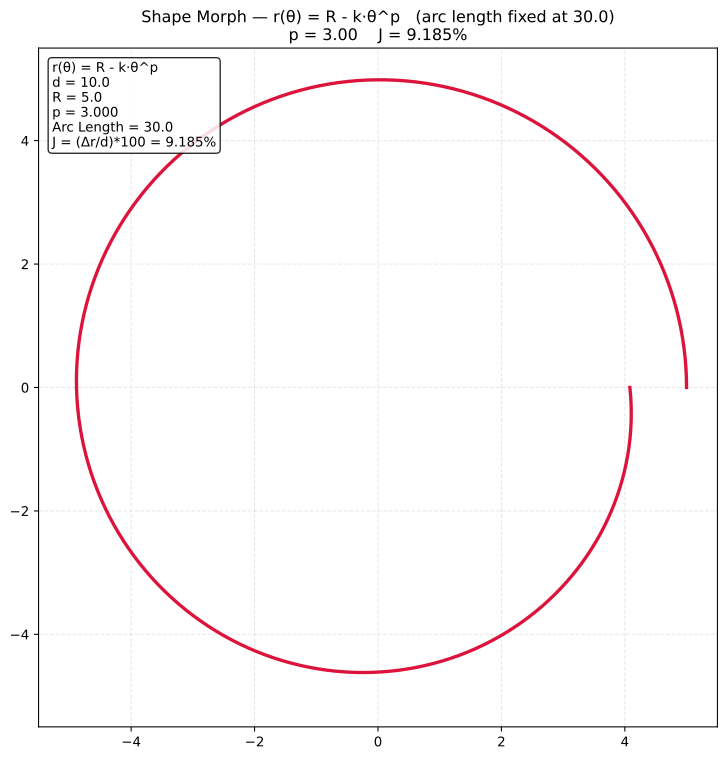
Animates the power-law exponent p from 0.3 → 3.0 → 0.3, redrawing the r(θ) = R − k·θp spiral live as J changes from ~2.99% to ~9.18%. Preview shows p = 3.0 (J ≈ 9.18%, the most back-loaded / highest-J shape).
The Race
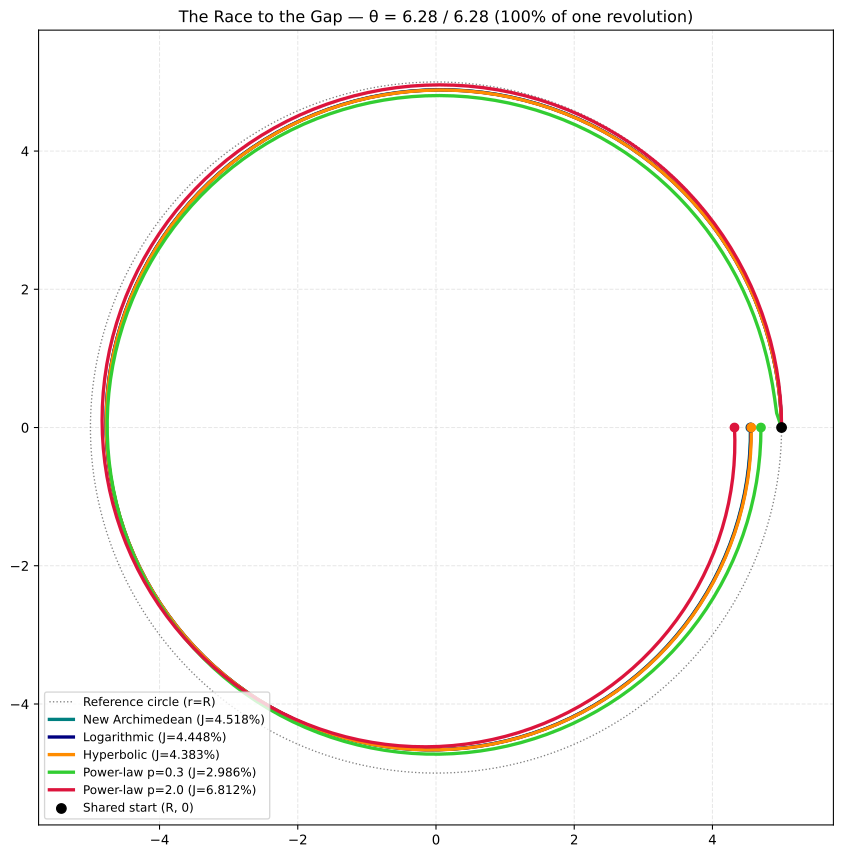
Five branches (New Archimedean, Logarithmic, Hyperbolic, Power-law p=0.3, Power-law p=2.0) all start at (R, 0) and race to θ = 2π — visualizing how differently each decay law "spends" the same arc-length budget.
The Full Unwind
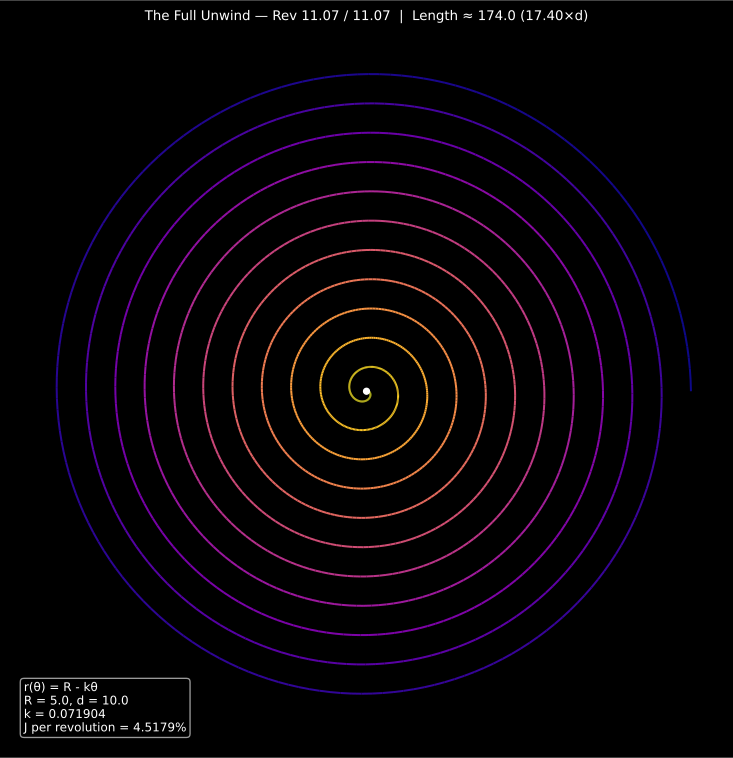
The New Archimedean (linear, Type-B) spiral continues past θ = 2π at the same rate k = 0.071904 until r(θ) = 0 — at θ ≈ 69.54 rad, i.e. 11.07 revolutions.
8.8Every J, Side By Side
| Branch | Decay law | J (%) | Self-similar for all n? |
|---|---|---|---|
| Type-A Archimedean (baseline) | r = R − (Δr/2π)θ, Δr = (1−3/π)d | 4.5070 | no |
| New Archimedean (Type-B, linear) | r = R − kθ | 4.5178 | no |
| Logarithmic — the J Spiral | r = R·e^(−kθ) | 4.4485 | yes |
| Hyperbolic | r = R/(1+kθ) | 4.3832 | no |
| Power-law p = 0.3 | r = R − kθ^p | 2.9861 | no |
| Power-law p = 0.5 | r = R − kθ^p | 3.3945 | no |
| Power-law p = 0.7 | r = R − kθ^p | 3.8389 | no |
| Power-law p = 1.5 | r = R − kθ^p | 5.6581 | no |
| Power-law p = 2.0 | r = R − kθ^p | 6.8117 | no |
| Power-law p = 3.0 | r = R − kθ^p | 9.1846 | no |
| Perfect Symmetry (3D, H = Δr) | z = −(H/2π)θ, H = Δr | 4.5070 | no |
| Gravity Well (3D, H → 0) | z = −H(1−e^(−cθ)) | 4.5070 | no |
2.99% – 9.18% total observed range of J across every model explored
↑ back to top